Malin Francke, Vaishali Arora, Andrea Dobri, and Jelena Barbir examines whether clear information about health risks from plastics and microplastics can increase people’s willingness to reduce plastic use, using a university student sample in Germany to test a simple educational intervention.
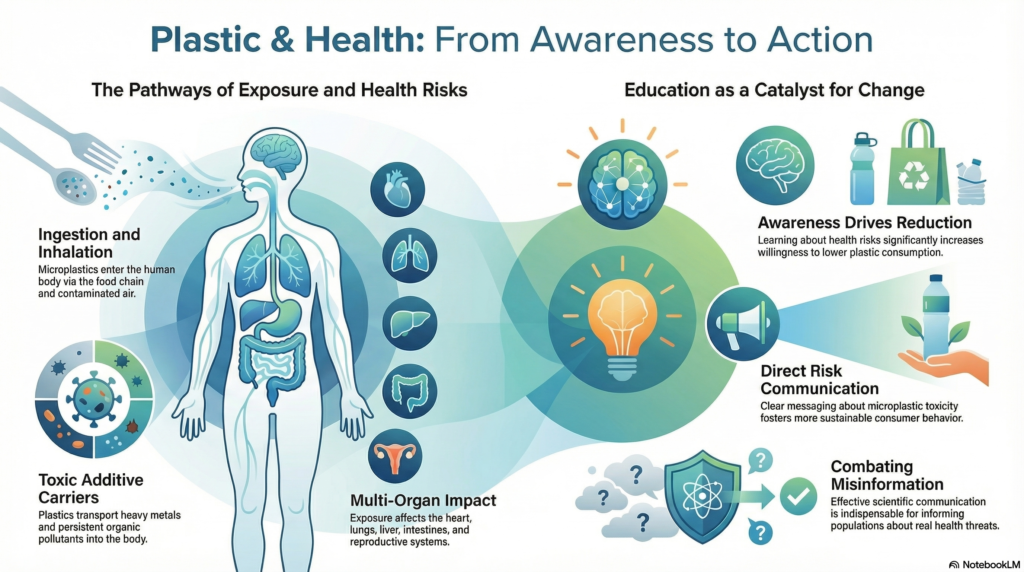
The authors start from the premise that microplastics are an emerging threat not only to ecosystems but also to human health, with exposure routes including food, water, and air. They situate their work within literature showing that environmental risk perception and knowledge strongly influence environmental concern, behavioral intentions, and sustainable consumption behavior. Against this backdrop of “alternative facts” and misinformation, the chapter argues that effective scientific communication is indispensable to inform the public about health risks and to motivate behavior change.
The empirical core of the chapter is a survey-based intervention study conducted with students at Hamburg University of Applied Sciences in Germany. Participants were first asked about their current plastic use, their willingness to reduce plastic consumption, and their knowledge and perceptions of risks from plastic pollution and microplastics to human health. The students then received an immediate informational intervention: clear, direct messages about the environmental and human health risks of plastics, especially microplastics and associated toxins. After this short intervention, the same constructs—willingness to reduce plastics, risk perception, and knowledge—were measured again to detect any change.
Statistical analysis showed that exposing students to information about plastic-related health risks significantly increased their reported willingness to reduce plastic consumption. The authors interpret this as evidence that raising awareness about human health impacts, not only environmental damage, can be a powerful additional lever for reducing plastic use. In particular, the intervention seemed effective because it framed microplastics and plastic pollution as a direct, personal health concern rather than a distant environmental issue.
The chapter embeds these findings in broader research on microplastics in food chains, indoor environments, seafood, drinking water, and human tissues, highlighting the growing documentation of microplastic exposure and potential toxicity. It draws on work linking environmental knowledge and risk perception to sustainable consumption among different populations, as well as on studies about risk communication and behavior change in domains like climate change and marine litter. This literature review underpins the authors’ assumption that targeted communication can bridge the gap between positive attitudes toward the environment and concrete behavior change regarding plastics.
At the same time, the authors acknowledge important limitations. The study is a short, one-off intervention with a relatively small, homogenous sample of university students in a single German city, which constrains generalizability. They note that the research design does not track long-term behavior; it measures self-reported willingness immediately after the intervention, not actual reductions in plastic use over time. Consequently, they call for more extensive, longitudinal, and diversified research to test how robust and durable such effects are in broader populations.
Despite these constraints, the chapter concludes that awareness and education about the health risks of plastics and microplastics are crucial components of strategies to curb plastic consumption. It suggests that policy makers, educators, and communicators should integrate human health framing into campaigns on plastic pollution, complementing environmental and climate narratives. The findings provide a proof of concept that even a brief, well-designed communication can shift intentions, supporting the wider use of science-based risk communication as a tool to reduce everyday plastic use and, by extension, plastic pollution.
Leave a Reply