Nikita E. Harvey, Lauren C.M. Ringer, Darcie Stapleton, Jayne Simmons, Karl J. Jobst and Lindsay S. Cahill explores what Canadian parents know about micro- and nanoplastics (MNPs) – and how ready they are to change their habits.
What this study asked
The authors surveyed 300 expecting parents and parents/guardians of children under 18 across Canada using an anonymous online questionnaire. They wanted to know four things:
- How much parents know about micro- and nanoplastics and related health research
- How much they trust decision makers (like government agencies) to regulate plastics
- How willing they are to change daily habits to reduce plastic exposure
- Whether education, age, income and other factors shape knowledge and willingness to act
What parents think they know
Most participants felt they had at least a basic handle on MNPs.
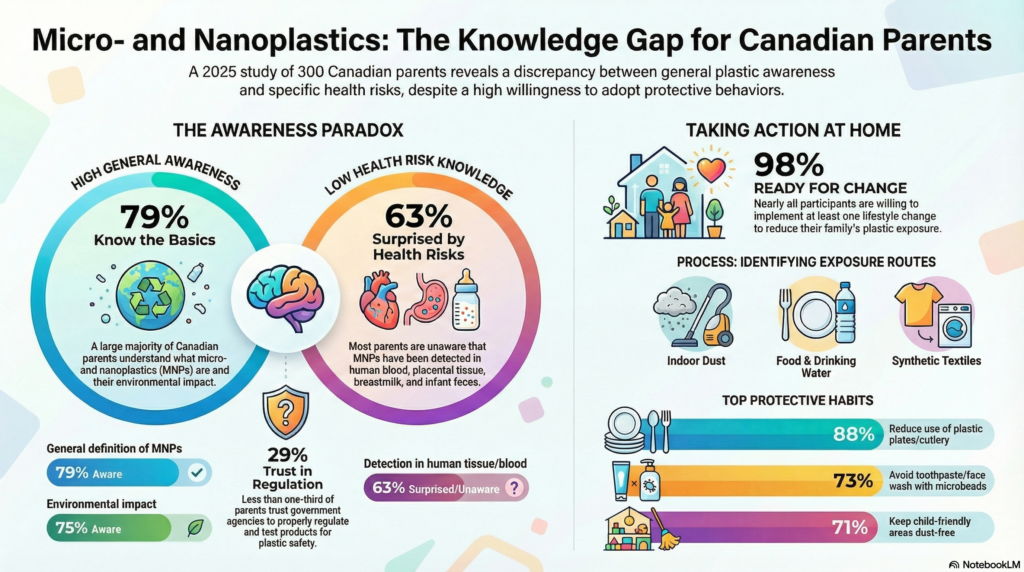
- 79% said they know what micro- and nanoplastics are
- 75% knew they significantly affect the environment
But when it came to human exposure and health, the knowledge gaps were big:
- Many were surprised that MNPs are in household products, food and drinking water
- 63% were very or somewhat surprised that MNPs have been found in human blood, placenta, breastmilk and infant feces
- 63% were unaware of any preclinical animal research on MNP exposure during pregnancy and fetal development
Education mattered. Parents with only a high school diploma were far more likely not to know what MNPs are or their environmental impact compared to those with university or graduate education.
Trust in government vs. personal action
Trust in government agencies to “properly regulate, accurately test and approve” products was low: only 29% said they trusted them. Yet personal willingness to act was strikingly high:
- 44% were willing to pay more for products with less plastic or reusable alternatives
- 98% were willing to make at least one change at home or in daily habits
- 82% were ready to make three or more changes to reduce plastic exposure
Commonly accepted changes included:
- 88% willing to reduce use of plastic plates, cutlery and water bottles
- 73% willing to avoid toothpaste and face wash with microbeads
- 71% willing to keep child-friendly areas more dust‑free
- 56% willing to substitute plastic toys with wooden ones
- 45% willing to buy more natural‑fiber clothing
Knowledge drives action
One of the most important findings: parents who knew more about MNPs were more willing to change.
- Those who knew about MNPs were more likely to pay extra for low‑plastic products (47% vs 32%)
- They were also more likely to choose three or more lifestyle changes to cut plastic exposure (82% vs 66%)
Education and income shaped behaviour too. Higher education was linked both to better MNP knowledge and to a higher willingness to change multiple habits.
What this means – and what’s next
Harvey and colleagues show a clear pattern: Canadian parents are worried enough about plastics to be highly motivated to act, even though many still don’t grasp how deeply MNPs have entered the human body and the emerging science around pregnancy and child health. The authors argue that better public communication – via email, blogs, webinars, documentaries and social media – is key to closing knowledge gaps without creating unnecessary fear, especially since the true risk to human health is still being worked out.
They also highlight that individual action is only part of the solution: low trust in government suggests researchers, clinicians and other experts should play a bigger public-facing role in shaping and communicating plastic policies.
Leave a Reply