Author: Dan

  • You’re Already Eating Plastic. Here’s What the Science Actually Says.

    You’re Already Eating Plastic. Here’s What the Science Actually Says.

    TL;DR

    A new review paper maps exactly where microplastics come from, where they go, and what they do to us. The picture is not great — but here’s what’s actually known vs. what’s still being figured out.

    • Microplastics are now found everywhere: Arctic snow, deep ocean, your blood.
    • You inhale more plastic than you eat — up to 15× more, by some estimates.
    • They damage lungs, gut, and potentially DNA. Long-term risks are still being studied.
    • Soils hold up to 23× more microplastics than the ocean. It’s a land problem, not just a sea problem.
    • Two main ways they break down: UV light and microbes — but it takes years to centuries.

    Here’s something nobody tells you at the grocery store: that bottle of water you just bought, those mussels you ordered, the air you’re breathing right now — all of them contain tiny fragments of plastic. Not trace amounts from some industrial accident. Just… everyday exposure, because we’ve put so much plastic into the world that it’s now cycling through the atmosphere, water, and soil the same way oxygen does.

    A comprehensive review published in Environmental Pollution this year lays out the full picture — and while it’s not panic-inducing, it’s the kind of thing you probably should know about.

    So how does it all get into everything?

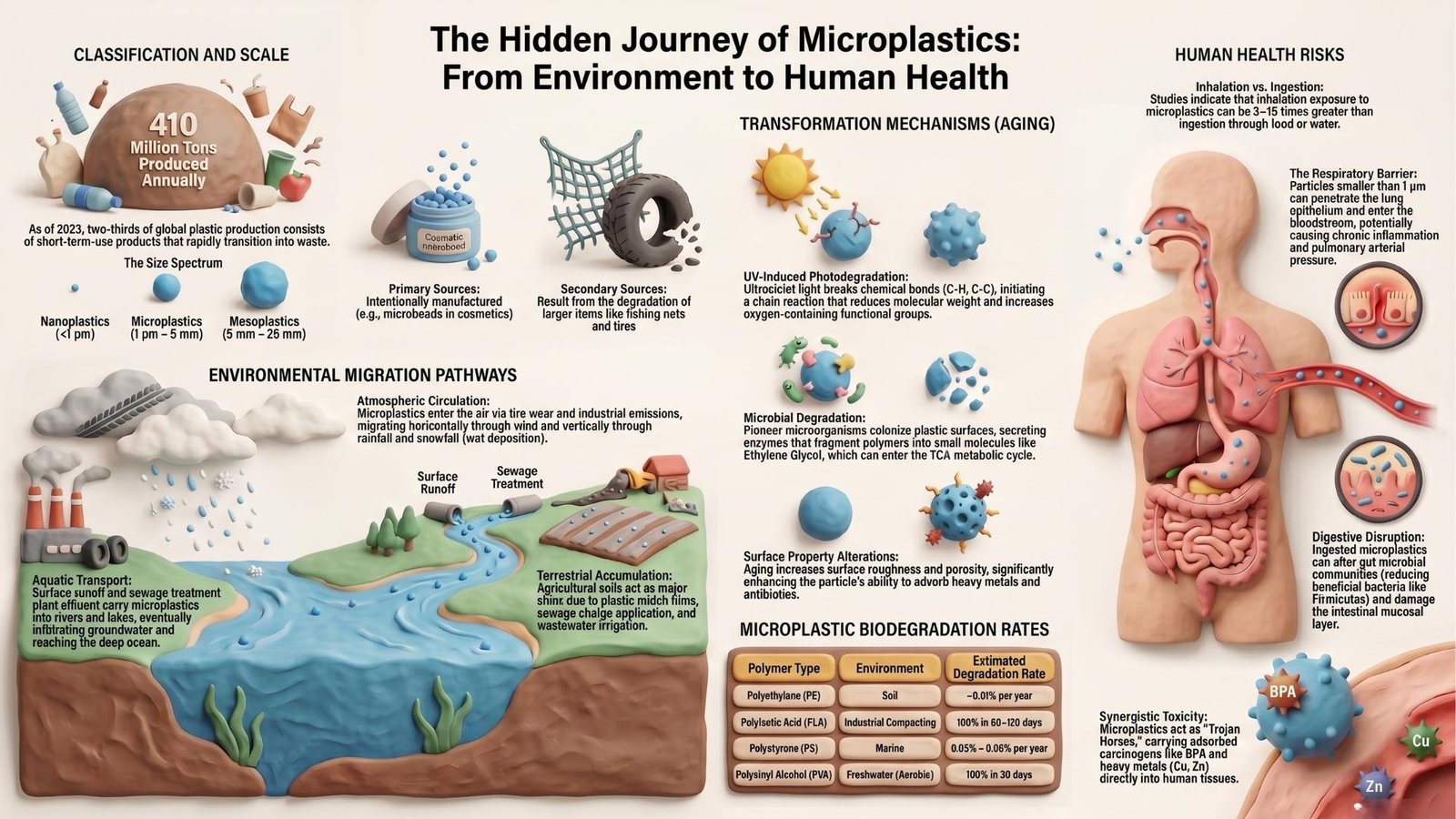
    Microplastics — defined as plastic particles smaller than 5mm — come from two places. Some are manufactured tiny on purpose, like the microbeads in old face scrubs. But most form when larger plastic breaks down over time through sunlight, heat, wind, and rain. Once they’re small enough, they go airborne. Wind carries them thousands of miles. They land in snowfall in the Arctic and on the peaks of the Himalayas. They wash into rivers, settle into soil, and get eaten by everything from plankton to earthworms.

    That last part surprises most people. We think of this as an ocean problem — and it is — but land is actually the bigger sink. Agricultural soils amended with sewage sludge can contain up to 7,000 microplastic particles per kilogram of soil. Those particles disrupt the microbes that keep soil fertile, affect earthworms, and get absorbed by plant roots. Eventually, they make it onto your plate.

    What happens when they’re inside you?

    This is where it gets genuinely unsettling. Microplastics have been detected in human blood, lung tissue, and colon tissue. Once inhaled, particles smaller than 1 micrometer can cross the lung lining and enter the bloodstream, from where they can reach other organs. Studies in mice show accumulation in the liver, kidneys, and intestines. In the gut, they’ve been linked to inflammation, disrupted gut bacteria, and — in lab settings — chromosomal damage.

    The authors are careful to note that most of the hard evidence on toxicity comes from animal models and lab organisms, not direct human studies. We don’t yet have a clean clinical picture of what decades of microplastic exposure does to a human body. But the mechanisms being observed — oxidative stress, immune activation, DNA strand breaks — are not benign ones.

    Can they break down?

    Yes, but slowly. UV light degrades plastics through a chain reaction that fragments polymer chains over time. Microbes can also colonize plastic surfaces and essentially eat them — but common plastics like polyethylene lose only about 0.01% of their mass per year in soil. Some specialized bioplastics compost in 60–120 days; conventional plastics are measured in decades to centuries. The science of speeding this up is an active and promising area of research, but we’re nowhere near a solution at scale.

    The bottom line: microplastic pollution is now genuinely global, measurably inside human bodies, and likely harmful at sufficient exposure — though the full scope of that harm is still being established. What’s clear is that the scientific community is no longer treating this as a niche environmental concern. It’s a public health question, and the answers are still being written.


    Source: Liu, J. & Zheng, L. (2025). “Microplastic migration and transformation pathways and exposure health risks.” Environmental Pollution, 368, 125700.
  • Microplastic diagnostics in humans: ‘The 3Ps’

    Microplastic diagnostics in humans: ‘The 3Ps’

    TL;DR:
    Microplastic diagnostics in humans: ‘The 3Ps’ Progress, problems, and prospects” by Gurusamy Kutralam‑Muniasamy, V.C. Shruti, Fermín Pérez‑Guevara and Priyadarsi D. Roy is a deep dive into how scientists actually detect microplastics in human bodies, what we’ve found so far (from blood to placenta to feces), why contamination and methods are a minefield, and where human microplastics research needs to go next.

    What this review is about

    This 2023 review pulls together everything we currently know about microplastics in human biological samples – think blood, lungs, liver, placenta, breastmilk, sputum, colon, feces and more. The authors systematically screened thousands of papers and narrowed it down to 20 high‑quality studies that actually identified polymers using robust techniques like FTIR, Raman, Py‑GC–MS or HPLC‑MS/MS. Their goal is to map the 3 Ps: progress, problems and prospects in “microplastic diagnostics” in humans.

    Progress: where we’ve got to

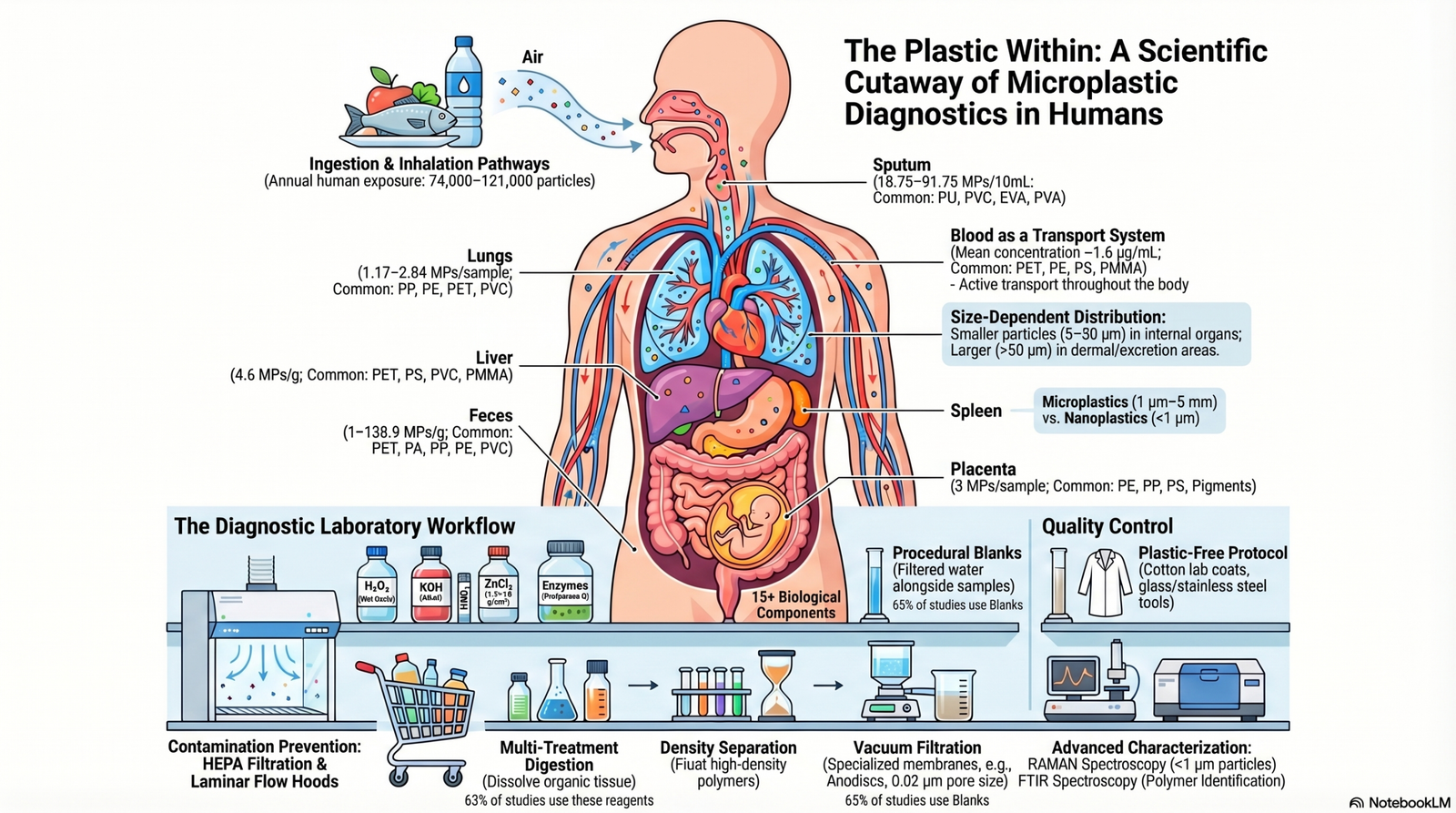
    The first paper on microplastics in human samples only appeared in 2019, but most of the selected studies were published in 2021–2022 – this field is exploding. Researchers have now reported microplastics in at least 15 human matrices, including blood, lung, liver, spleen, placenta, meconium, breastmilk, colon, saliva, sputum, hair, skin, hands and feces. Feces is the most commonly studied sample because it’s non‑invasive and gives a snapshot of gut exposure.

    On the lab side, the paper walks through the full diagnostic pipeline:

    • Sampling: invasive (tissues, blood, BALF) vs non‑invasive (saliva, hair, skin, feces, breastmilk)
    • Digestion & isolation: combinations of H₂O₂, KOH, NaOH, HNO₃, enzymes and density separation (CaCl₂, ZnCl₂) to strip away organic matter without destroying plastics
    • Detection: Raman and FTIR spectroscopy, Nile Red staining, Py‑GC–MS and HPLC‑MS/MS, often in combination for polymer ID and size distribution

    Raman is emerging as a workhorse because it can detect particles below 1 μm, which matters when we care about particles small enough to cross cell membranes.

    What’s actually in us?

    Across the 20 studies, microplastics were detected in almost all sample types, with 0–100% prevalence depending on organ and study design. Reported mean levels (very rough baseline numbers) include: about 1.6 μg/mL in blood, a few MPs per gram in placenta, meconium, liver and lung, and from roughly 1 to 139 particles per gram in feces. Shapes are mostly fibres and fragments, dominated by transparent/white and blue particles; sizes range from ~700 nm up to 5 mm, with smaller particles (<50 μm) turning up more in internal tissues and larger ones in skin, hands, hair and stool.

    Polymer types span the usual suspects – PET, PE, PP, PVC, PS and a long list of engineering and specialty polymers – with over 45 plastic types reported in human samples. Some studies link polymer signatures in tissues to what people actually eat and use (e.g., food, drinking water, personal care products), underlining that ingestion and inhalation from multiple sources are feeding the body burden.

    Intriguingly, some papers report higher microplastic loads in diseased tissues (e.g., cirrhotic liver, lung nodules, inflammatory bowel disease) than in healthy controls, but the review stresses we don’t yet know if plastics contribute to disease, or if disease simply makes retention easier.

    Problems: contamination and lack of standards

    The “problems” section is a reality check for microplastics‑in‑humans headlines. Cross‑contamination is everywhere: fibres from air, lab coats, masks, filters and plastic labware can easily fake a signal. Many studies use blanks, but often only visually, without full polymer ID, and some show the same polymers in blanks and samples – at least 30% of studies in this review were clearly affected by contamination issues.

    On top of that:

    • Contamination‑control practices (clean rooms, HEPA‑filtered air, laminar flow hoods, plastic‑free protocols) are highly inconsistent.
    • Extraction chemistries like 65% HNO₃ can damage polymers and under‑estimate real loads.
    • Recovery tests are rare outside feces and blood, so we often don’t know how much we’re losing.

    There is no standard method yet for any human matrix, which makes cross‑study comparison very shaky.

    Prospects: what needs to happen next

    In the “prospects” section, the authors outline a research roadmap. Priorities include:

    • More and larger biomonitoring studies outside Europe and Asia, including far more work on children and vulnerable subgroups.
    • Longitudinal follow‑up of patients with documented microplastic loads in tissues, to see how levels change and whether they track disease.
    • Better, standardized contamination‑control protocols and recovery experiments for every matrix.
    • Deeper toxicology on microplastics and their co‑contaminants, plus an urgent push into nanoplastics, which animal work already shows can be absorbed and excreted in urine.
    • Translating all this into clear public communication, not just specialist papers.

    The big message: microplastics in humans are real, globally relevant, and technically challenging to measure – and we’re only at the start of building reliable diagnostics that can link exposure to real health outcomes.

  • Opinions of parents and parents-to-be on micro- and nanoplastics: knowledge and willingness to implement change in Canada

    Nikita E. Harvey, Lauren C.M. Ringer, Darcie Stapleton, Jayne Simmons, Karl J. Jobst and Lindsay S. Cahill explores what Canadian parents know about micro- and nanoplastics (MNPs) – and how ready they are to change their habits.

    What this study asked

    The authors surveyed 300 expecting parents and parents/guardians of children under 18 across Canada using an anonymous online questionnaire. They wanted to know four things:

    • How much parents know about micro- and nanoplastics and related health research
    • How much they trust decision makers (like government agencies) to regulate plastics
    • How willing they are to change daily habits to reduce plastic exposure
    • Whether education, age, income and other factors shape knowledge and willingness to act

    What parents think they know

    Most participants felt they had at least a basic handle on MNPs.

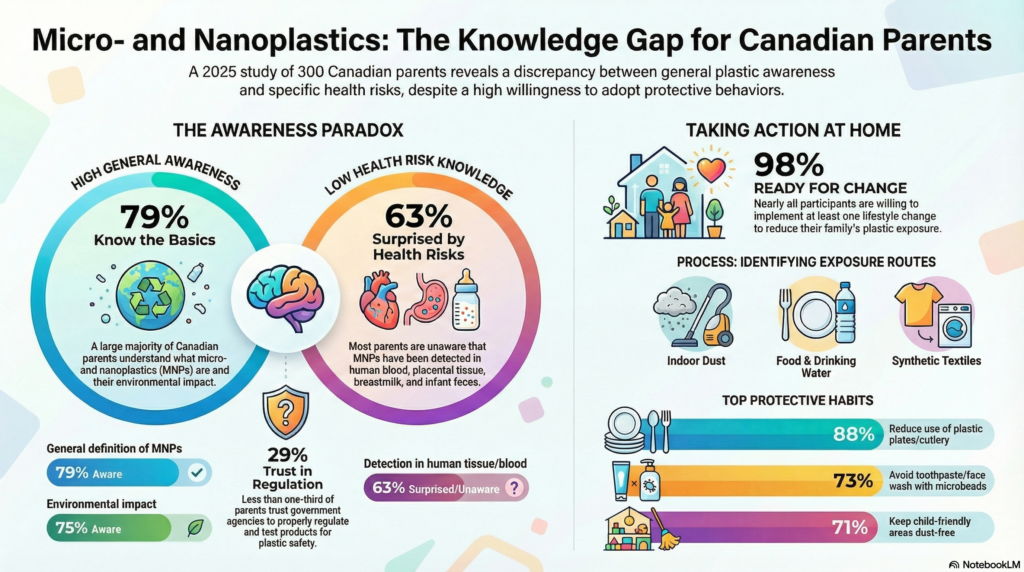
    • 79% said they know what micro- and nanoplastics are
    • 75% knew they significantly affect the environment

    But when it came to human exposure and health, the knowledge gaps were big:

    • Many were surprised that MNPs are in household products, food and drinking water
    • 63% were very or somewhat surprised that MNPs have been found in human blood, placenta, breastmilk and infant feces
    • 63% were unaware of any preclinical animal research on MNP exposure during pregnancy and fetal development

    Education mattered. Parents with only a high school diploma were far more likely not to know what MNPs are or their environmental impact compared to those with university or graduate education.

    Trust in government vs. personal action

    Trust in government agencies to “properly regulate, accurately test and approve” products was low: only 29% said they trusted them. Yet personal willingness to act was strikingly high:

    • 44% were willing to pay more for products with less plastic or reusable alternatives
    • 98% were willing to make at least one change at home or in daily habits
    • 82% were ready to make three or more changes to reduce plastic exposure

    Commonly accepted changes included:

    • 88% willing to reduce use of plastic plates, cutlery and water bottles
    • 73% willing to avoid toothpaste and face wash with microbeads
    • 71% willing to keep child-friendly areas more dust‑free
    • 56% willing to substitute plastic toys with wooden ones
    • 45% willing to buy more natural‑fiber clothing

    Knowledge drives action

    One of the most important findings: parents who knew more about MNPs were more willing to change.

    • Those who knew about MNPs were more likely to pay extra for low‑plastic products (47% vs 32%)
    • They were also more likely to choose three or more lifestyle changes to cut plastic exposure (82% vs 66%)

    Education and income shaped behaviour too. Higher education was linked both to better MNP knowledge and to a higher willingness to change multiple habits.

    What this means – and what’s next

    Harvey and colleagues show a clear pattern: Canadian parents are worried enough about plastics to be highly motivated to act, even though many still don’t grasp how deeply MNPs have entered the human body and the emerging science around pregnancy and child health. The authors argue that better public communication – via email, blogs, webinars, documentaries and social media – is key to closing knowledge gaps without creating unnecessary fear, especially since the true risk to human health is still being worked out.

    They also highlight that individual action is only part of the solution: low trust in government suggests researchers, clinicians and other experts should play a bigger public-facing role in shaping and communicating plastic policies.

  • Plastics and Human Health: How Perception of Human Health Risks Can Reduce Plastics Consumption?

    Malin Francke, Vaishali Arora, Andrea Dobri, and Jelena Barbir examines whether clear information about health risks from plastics and microplastics can increase people’s willingness to reduce plastic use, using a university student sample in Germany to test a simple educational intervention.

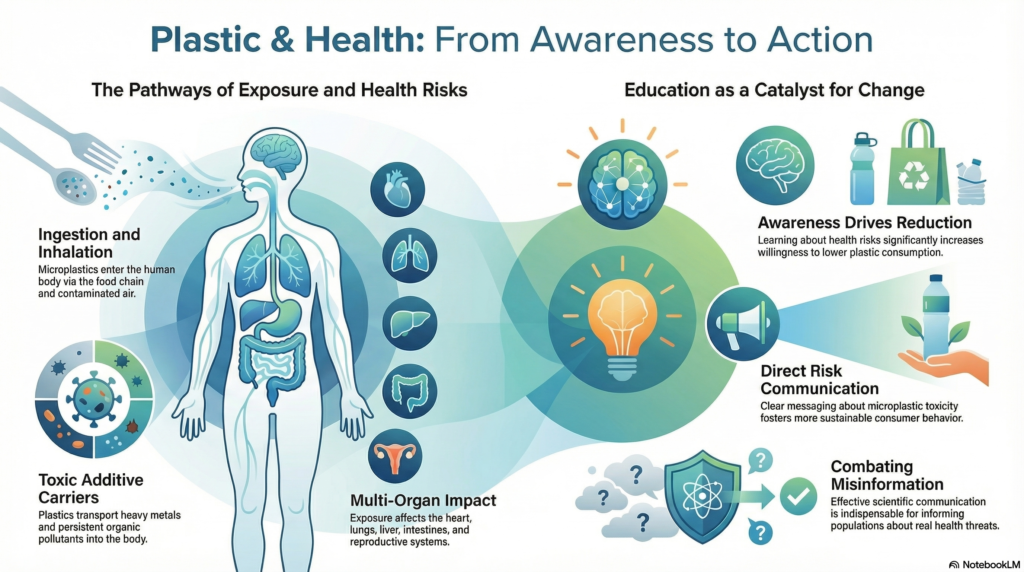
    The authors start from the premise that microplastics are an emerging threat not only to ecosystems but also to human health, with exposure routes including food, water, and air. They situate their work within literature showing that environmental risk perception and knowledge strongly influence environmental concern, behavioral intentions, and sustainable consumption behavior. Against this backdrop of “alternative facts” and misinformation, the chapter argues that effective scientific communication is indispensable to inform the public about health risks and to motivate behavior change.

    The empirical core of the chapter is a survey-based intervention study conducted with students at Hamburg University of Applied Sciences in Germany. Participants were first asked about their current plastic use, their willingness to reduce plastic consumption, and their knowledge and perceptions of risks from plastic pollution and microplastics to human health. The students then received an immediate informational intervention: clear, direct messages about the environmental and human health risks of plastics, especially microplastics and associated toxins. After this short intervention, the same constructs—willingness to reduce plastics, risk perception, and knowledge—were measured again to detect any change.

    Statistical analysis showed that exposing students to information about plastic-related health risks significantly increased their reported willingness to reduce plastic consumption. The authors interpret this as evidence that raising awareness about human health impacts, not only environmental damage, can be a powerful additional lever for reducing plastic use. In particular, the intervention seemed effective because it framed microplastics and plastic pollution as a direct, personal health concern rather than a distant environmental issue.

    The chapter embeds these findings in broader research on microplastics in food chains, indoor environments, seafood, drinking water, and human tissues, highlighting the growing documentation of microplastic exposure and potential toxicity. It draws on work linking environmental knowledge and risk perception to sustainable consumption among different populations, as well as on studies about risk communication and behavior change in domains like climate change and marine litter. This literature review underpins the authors’ assumption that targeted communication can bridge the gap between positive attitudes toward the environment and concrete behavior change regarding plastics.

    At the same time, the authors acknowledge important limitations. The study is a short, one-off intervention with a relatively small, homogenous sample of university students in a single German city, which constrains generalizability. They note that the research design does not track long-term behavior; it measures self-reported willingness immediately after the intervention, not actual reductions in plastic use over time. Consequently, they call for more extensive, longitudinal, and diversified research to test how robust and durable such effects are in broader populations.

    Despite these constraints, the chapter concludes that awareness and education about the health risks of plastics and microplastics are crucial components of strategies to curb plastic consumption. It suggests that policy makers, educators, and communicators should integrate human health framing into campaigns on plastic pollution, complementing environmental and climate narratives. The findings provide a proof of concept that even a brief, well-designed communication can shift intentions, supporting the wider use of science-based risk communication as a tool to reduce everyday plastic use and, by extension, plastic pollution.

  • The invisible enemy. Public knowledge of microplastics is needed to face the current microplastics crisis

    Eva Garcia-Vazquez (University of Oviedo, Spain) and Cristina Garcia-Ael (UNED, Madrid, Spain), published in Sustainable Production and Consumption (2021).

    This systematic review analyzes psychosocial factors influencing public responses to the microplastic crisis, emphasizing knowledge gaps and pro-environmental behaviors. Microplastics (<5 mm), either primary (e.g., microbeads in cosmetics) or secondary (e.g., fibers from laundry), pollute oceans via land runoff, wastewater, and degradation, threatening biodiversity, climate, and human health through ingestion and inhalation. Despite global efforts like UN SDG 14 and bans on microbeads, top-down governance overlooks public awareness, as citizens drive emissions via consumption.

    Methods

    Following PRISMA, authors searched databases (PsycINFO, Web of Science, etc.) using terms like “microplastics AND psychology” up to January 2021, retaining 33 peer-reviewed articles (17 with original data) after filtering 994 hits. They coded psychosocial variables (knowledge, awareness, risk perception), used contingency statistics on keywords, and clustered terms via VOSviewer from titles/abstracts/keywords. Hypotheses tested: knowledge drives behavior; invisibility relies on external info; values mediate change.

    Key Findings

    Knowledge emerged central, linking directly to willingness-to-pay (WTP) and behavior change (e.g., avoiding microbead products post-education). Experimental studies (e.g., brochures, modules) boosted awareness; media/internet are primary sources, but science communication is poor. Risk perception and control were secondary; values/attitudes mattered variably.

    Research skews European (11/17 studies), ignoring Africa despite high emissions; cultural differences exist (e.g., higher WTP in low-trust Portugal vs. Germany/Norway). Sociodemographics: education correlates with awareness; age/gender effects inconsistent. Clustering showed “knowledge” → “consumers” → “microplastic pollution” → “WTP/behavior.”

    AspectPrimary MicroplasticsSecondary Microplastics
    SourcesCosmetics, abrasives Laundry fibers, degradation 
    BehaviorsAvoid products Reduce/reuse/recycle plastics 
    StudiesFewer, e.g., US students refuse cleansers More, e.g., green clothing intent 

    Implications and Recommendations

    Knowledge trumps risk perception for action; invisibility/spatial distance hinders change. Reviews focus governance; data emphasize individuals. Propose: knowledge baselines; value mediation studies; expand to Africa/intercultural work; industry/politician views; better science outreach (visuals, e.g., Artemia videos); education integration.

  • Association between microplastics and the functionalities of human gut microbiome

    Authors: Bei Gao, Lixia Chen, Lizhi Wu, Shirui Zhang, Sunan Zhao, Zhe Mo, Zhijian Chen, Pengcheng Tu

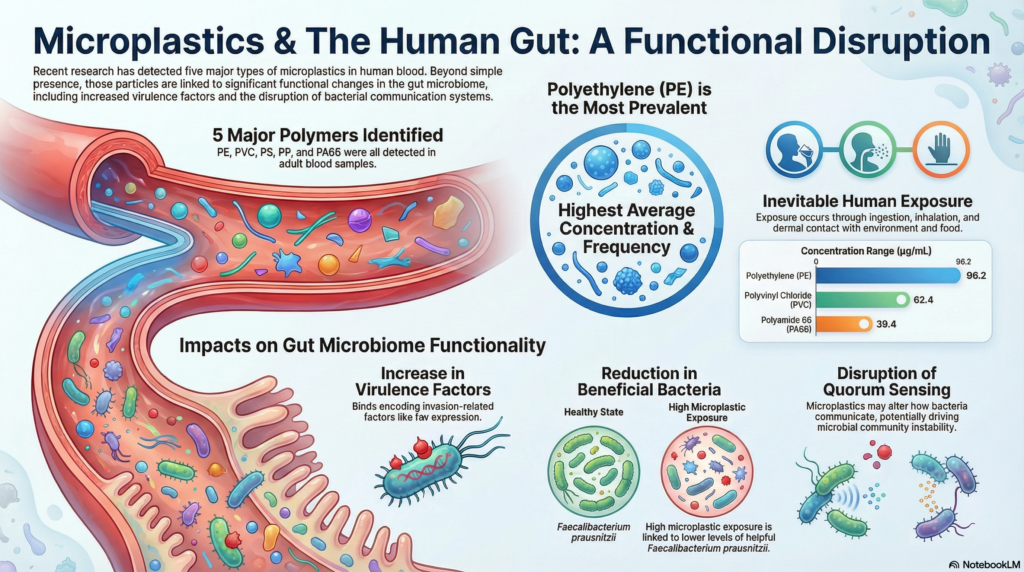
    This pilot study investigates how microplastics detected in human blood relate not only to gut microbiome composition but, crucially, to its functional capacities, including virulence, quorum sensing, transport, and biodegradation pathways.

    The authors measured microplastics in blood from 39 healthy adults (25–69 years) in two counties in Zhejiang Province, China, excluding subjects with major systemic disease or recent antibiotic use. Using pyrolysis–GC/MS, they detected five polymers—polyethylene (PE), polyvinyl chloride (PVC), polystyrene (PS), polypropylene (PP), and polyamide 66 (PA66)—with PE most frequently detected and at the highest average concentration; PA66 levels were higher in women, while other polymers showed no sex difference. Participants were stratified into low- and high-exposure groups based on total blood microplastic burden.

    Shotgun metagenomic sequencing of stool from 34 participants was used to profile microbial taxa and functional genes, focusing on: virulence factors, quorum sensing (including autoinducers, receptors, and effectors), transporter systems, and enzymes involved in microplastic and plasticizer biodegradation. Alpha and beta diversity metrics did not differ significantly between sexes or between low- and high-exposure groups, indicating that microplastics were more strongly linked to functional shifts than to broad community diversity changes.

    At the species level, microplastic burden positively correlated with potentially pathogenic taxa such as Escherichia coli and unclassified Enterobacteriaceae, and negatively with Faecalibacterium prausnitzii and related Faecalibacterium species, a group associated with gut and systemic health. Consistently, F. prausnitzii abundance was significantly higher in the low-exposure group than in the high-exposure group.

    Functionally, microplastics showed positive correlations with genes encoding invasion-related virulence factors, including Ail, Invasin C, type III secretion systems (TTSS and Bsa T3SS) and type 1 fimbriae, whereas flagella-related genes were negatively associated with several polymers. In exposure-group comparisons, flagella genes were enriched in the low-exposure group, while LpeA (another virulence-related factor) was elevated in the high-exposure group.

    In the quorum sensing system, microplastics were positively associated with effector genes but negatively associated with autoinducer and autoinducer receptor genes, particularly for PS, PE, and PVC. The low-exposure group showed higher relative abundance of autoinducer receptor genes and the autoinducer enzyme aldose 1-epimerase, consistent with correlation analyses, while several autoinducer-related genes were depleted in the high-exposure group. These patterns suggest that microplastics may disrupt cell–cell communication networks that underpin microbial community organization and behavior.

    Microplastics also correlated with transporter functions: PP levels were positively associated with genes for group translocators and electrochemical potential–driven transporters, and multiple polymers correlated with transmembrane electron carriers. Specific redox-related enzymes—such as disulfide bond oxidoreductase, nitrate reductase, dimethyl sulfoxide reductase, trimethylamine-N-oxide reductase, thiosulfate reductase, and sulfoxide reductase—were positively associated with microplastics, and dimethyl sulfoxide reductase DmsABC was enriched in the high-exposure group.

    Importantly, the gut metagenome contained genes encoding enzymes implicated in the biodegradation of PVC, PS, PE, nylon, and plasticizers (DEHP, diethyl phthalate), including acetyl-CoA acetyltransferase, 3‑hydroxyacyl-CoA dehydrogenase, catalase–peroxidase, and acetaldehyde dehydrogenase. Blood levels of PVC, PP, PE, and PS were positively correlated with these microplastic and plasticizer biodegradation genes, suggesting that gut microbes may adapt metabolically to chronic microplastic exposure.

    To support causality, the authors exposed C57BL/6 male mice to 5 µm PS microplastics (80 mg/kg/day, 14 weeks) and found significant alterations in gut microbial composition and in microbial genes related to invasion-associated virulence factors, autoinducers, and transmembrane electron carriers. These animal results parallel the human associations and strengthen the argument that microplastics can actively reshape gut microbial functions.

    The discussion integrates these findings with broader literature, proposing that microplastics may drive functional dysbiosis through impacts on quorum sensing, biofilm formation, virulence, immune modulation, and redox metabolism, with potential downstream effects on gut barrier integrity, inflammation, and systemic disease risk. However, the authors emphasize key limitations: small sample size, residual confounding (diet, lifestyle, acute and chronic stimuli), and the observational design, which permits only correlation, not definitive causation, in humans. They conclude that circulating microplastics are linked to specific compositional and functional alterations in the gut microbiome, highlighting quorum sensing disruption and enhanced biodegradation capacity as possible mechanisms and underscoring the need for larger, longitudinal human studies to assess health risks.