Authors: Bei Gao, Lixia Chen, Lizhi Wu, Shirui Zhang, Sunan Zhao, Zhe Mo, Zhijian Chen, Pengcheng Tu
This pilot study investigates how microplastics detected in human blood relate not only to gut microbiome composition but, crucially, to its functional capacities, including virulence, quorum sensing, transport, and biodegradation pathways.
The authors measured microplastics in blood from 39 healthy adults (25–69 years) in two counties in Zhejiang Province, China, excluding subjects with major systemic disease or recent antibiotic use. Using pyrolysis–GC/MS, they detected five polymers—polyethylene (PE), polyvinyl chloride (PVC), polystyrene (PS), polypropylene (PP), and polyamide 66 (PA66)—with PE most frequently detected and at the highest average concentration; PA66 levels were higher in women, while other polymers showed no sex difference. Participants were stratified into low- and high-exposure groups based on total blood microplastic burden.
Shotgun metagenomic sequencing of stool from 34 participants was used to profile microbial taxa and functional genes, focusing on: virulence factors, quorum sensing (including autoinducers, receptors, and effectors), transporter systems, and enzymes involved in microplastic and plasticizer biodegradation. Alpha and beta diversity metrics did not differ significantly between sexes or between low- and high-exposure groups, indicating that microplastics were more strongly linked to functional shifts than to broad community diversity changes.
At the species level, microplastic burden positively correlated with potentially pathogenic taxa such as Escherichia coli and unclassified Enterobacteriaceae, and negatively with Faecalibacterium prausnitzii and related Faecalibacterium species, a group associated with gut and systemic health. Consistently, F. prausnitzii abundance was significantly higher in the low-exposure group than in the high-exposure group.
Functionally, microplastics showed positive correlations with genes encoding invasion-related virulence factors, including Ail, Invasin C, type III secretion systems (TTSS and Bsa T3SS) and type 1 fimbriae, whereas flagella-related genes were negatively associated with several polymers. In exposure-group comparisons, flagella genes were enriched in the low-exposure group, while LpeA (another virulence-related factor) was elevated in the high-exposure group.
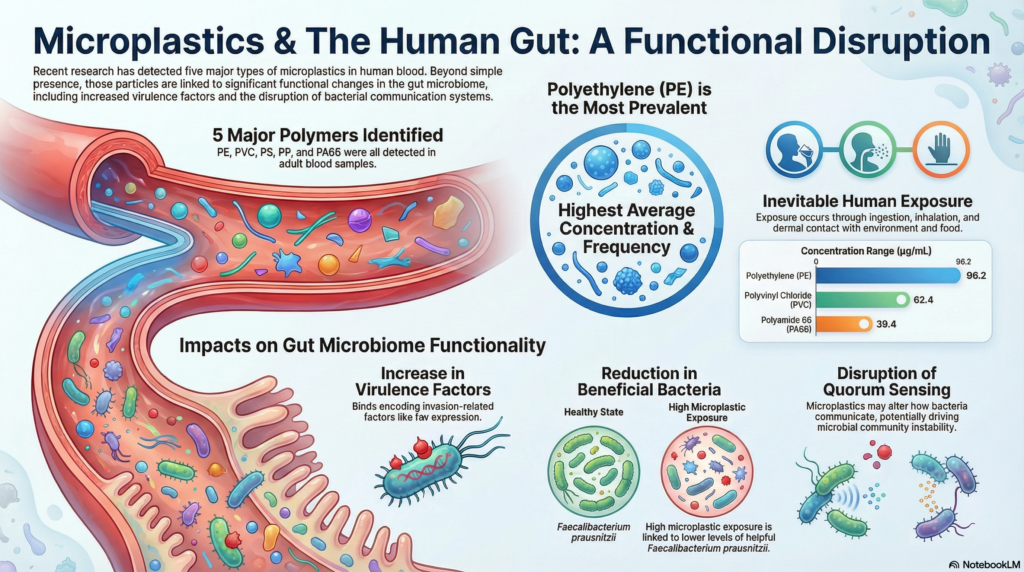
In the quorum sensing system, microplastics were positively associated with effector genes but negatively associated with autoinducer and autoinducer receptor genes, particularly for PS, PE, and PVC. The low-exposure group showed higher relative abundance of autoinducer receptor genes and the autoinducer enzyme aldose 1-epimerase, consistent with correlation analyses, while several autoinducer-related genes were depleted in the high-exposure group. These patterns suggest that microplastics may disrupt cell–cell communication networks that underpin microbial community organization and behavior.
Microplastics also correlated with transporter functions: PP levels were positively associated with genes for group translocators and electrochemical potential–driven transporters, and multiple polymers correlated with transmembrane electron carriers. Specific redox-related enzymes—such as disulfide bond oxidoreductase, nitrate reductase, dimethyl sulfoxide reductase, trimethylamine-N-oxide reductase, thiosulfate reductase, and sulfoxide reductase—were positively associated with microplastics, and dimethyl sulfoxide reductase DmsABC was enriched in the high-exposure group.
Importantly, the gut metagenome contained genes encoding enzymes implicated in the biodegradation of PVC, PS, PE, nylon, and plasticizers (DEHP, diethyl phthalate), including acetyl-CoA acetyltransferase, 3‑hydroxyacyl-CoA dehydrogenase, catalase–peroxidase, and acetaldehyde dehydrogenase. Blood levels of PVC, PP, PE, and PS were positively correlated with these microplastic and plasticizer biodegradation genes, suggesting that gut microbes may adapt metabolically to chronic microplastic exposure.
To support causality, the authors exposed C57BL/6 male mice to 5 µm PS microplastics (80 mg/kg/day, 14 weeks) and found significant alterations in gut microbial composition and in microbial genes related to invasion-associated virulence factors, autoinducers, and transmembrane electron carriers. These animal results parallel the human associations and strengthen the argument that microplastics can actively reshape gut microbial functions.
The discussion integrates these findings with broader literature, proposing that microplastics may drive functional dysbiosis through impacts on quorum sensing, biofilm formation, virulence, immune modulation, and redox metabolism, with potential downstream effects on gut barrier integrity, inflammation, and systemic disease risk. However, the authors emphasize key limitations: small sample size, residual confounding (diet, lifestyle, acute and chronic stimuli), and the observational design, which permits only correlation, not definitive causation, in humans. They conclude that circulating microplastics are linked to specific compositional and functional alterations in the gut microbiome, highlighting quorum sensing disruption and enhanced biodegradation capacity as possible mechanisms and underscoring the need for larger, longitudinal human studies to assess health risks.